

Raw Transcript
[Music]
Up next on our second viewer call-in program of this evening, we look at the
recent controversy over the book Satanic Verses by author Salman Rushdie.
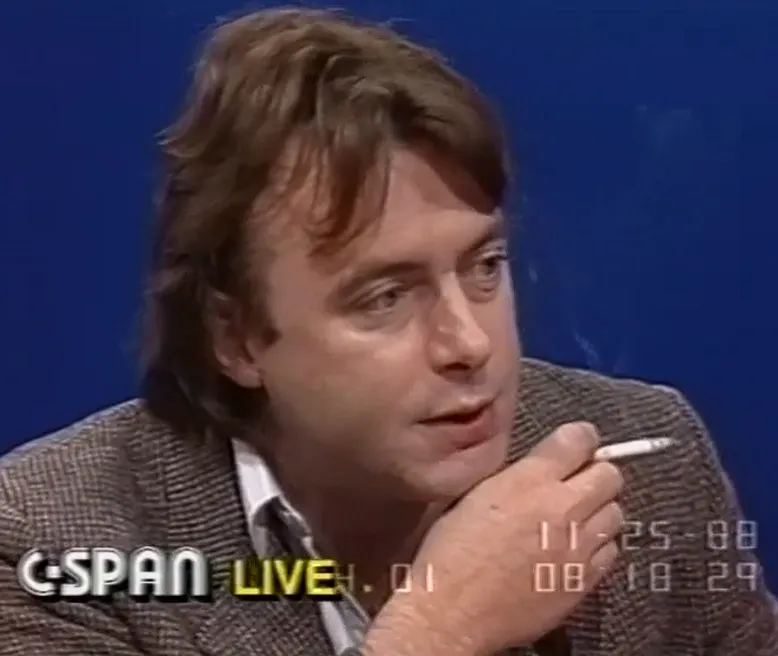
Our guest is Christopher Hitchens, columnist for The Nation.
[Music] [Music] [Music] [Music] [Music] [Music] [Music] [Music]
Christopher Hitchens, what is your view about the American literary community’s response to the death warrant
issued by the Ayatollah against the author of Satanic versus Salman Rushdie?
Well, tomorrow is the birthday of George Washington, and tomorrow the shopping malls of the United States,
which contain now one-third of the book outlets in this country, will of their
own volition not sell that book because they’re scared of a foreign despot.
Now, in my opinion, for that to happen
in this country on Washington’s birthday, to be scared of a crazy foreign tyrant in this way is a
really serious challenge to what we think of as the safe assumption of free speech and free
inquiry, free expression, and the necessity to defend it.
And in a way, though I find all this
very depressing, I welcome it because maybe we need every generation also to remind ourselves that
it’s not a free right to have free expression, not a free right to have a free society, and that it does need to be defended.
But this has got off to a very bad start, very bad start.
Christopher Hitchens is our guest. Our phone lines are open.
The subject is how America and the world literary community, including publishers, is responding to the Salman Rushdie situation.
The phone lines are open. You can begin dialing now.
We’ll spend a few more minutes with our guests, and then we’ll open the phones to you.
Area code 202-628-2525 is the number for those
of you living and calling from the eastern and central time zones.
Those living and calling from the mountain and pacific time zones 202-783-2727, those outside the United States, dial the
appropriate country code, and then 202-737-6734 is the number for you.
There’s a story in the Washington Post on Saturday this past weekend headlined “Silence in the Eye of the Rushdie Storm.
” Fear has swept the North American literary and publishing establishment in the wake of
Ayatollah Khomeini’s death sentence on novelist Salman Rushdie, author of the Satanic Verses,
even talked about Canada barring importation of the books.
Do you want to characterize any of that?
Yeah, look, I mean, I know that a lot of people who will in the ordinary way when it’s some imprisoned
Czechoslovakian playwright like Vaslav Havel, who’s actually on trial this week,
or someone in Chile or South Africa or Poland, will, you know, automatically sign.
There’s a list. Everyone sort of knows it.
People you can call, famous American writers who will put their names to the defense of the freedom
of others not so fortunate.
In this case, some of these people decided to pass, and some of them,
one of them is quoted in that story, said it was because they were frightened, and for me, the
most depressing moment of reading that story was when Arthur Miller said that. Arthur Miller
was a hero to many of us when we were young, before we were writers, because of his tremendous bravery
in the face of the McCarthy hearings, and the play that he wrote, and the plays and books that he’s
written on the theme of free expression, that he should say that he is scared to associate with
a protest where a writer’s life has been directly threatened, and where
his books are being burned, and the threat is that he will be burned too.
It just makes me very sad.
Now, the same justification I don’t think applies to bookstores like B.
Dalton and Walden Books,
who’ve pulled the book from their shelves, deprived Americans of the chance
to read the book for themselves. That’s a merely commercial consideration.
They haven’t been threatened.
No one’s asked to go on TV and show their face and say, you know, give the aitola the lie and say, all right, I don’t care what you think.
I prefer to exercise my rights. And then we have, sorry to drone on, Bruce, but just one final thing before we say.
I think it’s been very sad that the religious leaders of the country have been so feeble.
They’ve all either said nothing, or as in the case of Cardinal Archbishop O’Connor of New York, have said they think the book is
blasphemous, and they’ve, as it were, directed their criticism at the book, instead of calling the aitola “hominio blasphemer” for using
religion to mount a contract killing, which is what he’s publicly done.
So that’s my take since you asked.
All right, and we’ve got you here, in part because you wrote this column that
appeared in the Friday edition of the New York Times, “Now Who Will Speak for Rushdie?
” What’s the reaction you’ve gotten to this column?
Well, nice of you to ask.
I mean, it shouldn’t be me who says, but actually the response was very positive. I think a lot of
people have rung me from around the country saying it’s what they wanted to read, which pleased me very much.
I think, look, the piece is full of cliches.
I say all the obvious stuff, all the things that we take in with our milk, freedom of expression, freedom from fear, and so on, but there
are certain days when cliches come alive, and I apparently was lucky to publish my cliches on
Friday, because, Friday last, because that was when people wanted to read
them. Youngstown, Ohio, first call for Christopher Hitchens. Go ahead, please.
Yes, Mr. I would like to address myself first of all.
I am a Muslim, but I don’t adhere to the Khomeini doctrine of Islam.
My question is, even though I believe in the absolute freedom of expression by anybody,
there is always a fine line where a sensible intellectual and educated person like Salman Rushdie
should really recognize.
Secondly, freedom of speech does not allow anybody, anybody to be also
extremist to the extent that he insults one billion Muslims.
The second comment I would like to address the host of this program.
I’ve been seeing this program for a long time and I admire it very much,
but so far every time there is an issue between Arab and Israelis or Muslim and non-Muslim,
you never ever bring to your program anybody represent the other view.
If there is really
freedom of speech and you believe in it, you should adhere yourself to it and you should allow the other side to present their view.
All your guests so far, they were representing the opposite view.
Why don’t you allow us?
We are eight million Muslim in America. We have a right
to be represented in your program and we have many Muslim scholars they
would like to present their view in your program. All right, sir, thank you.
I’ll respond to that after we hear from Mr. Hitchens.
There’s a mistake at the heart of what you say, sir.
You say that though you are for free speech,
you aren’t for the exercise of free speech if it offends Muslims and you say that that is the line that we draw.
As a matter of fact, you’re in error.
First Amendment to the Constitution allows anyone who wants to insult anyone they like in any way they choose.
That includes belief in religion,
which is especially given no particular protection by that amendment, which is in fact rightly described as the cornerstone of our liberty.
Now that’s just the fact of the matter. I can say what I like about your
religion and you can say what you like about my humanism and I will not attempt
to prevent you from doing that.
In fact, so far from that, I would defend anyone who tried to make you be silent.
That is the foundation of what we call the Enlightenment. It’s terrible to have to be saying this because it’s ABC, but there it is.
Now to your point about the insult, I have read the book, I don’t know
if you have, and I’m clear in my mind that no insult to the prophet or to
those who believe in the God of whom he’s the messenger is intended.
The words that are complained of are spoken by a sick man suffering from paranoid schizophrenia in a dream in which he
believes himself to be the archangel Gabriel, who is a Christian icon.
So I think that’s about as far fictionally as you could go to avoid the charge of blasphemy, but I must add that if someone, Rushdie,
had wished to be blasphemous, had wished to challenge the tenets of your faith, that would also be his right.
So don’t confuse me in giving you two answers.
I mean them to be separate but related.
And to the caller, I would say that we make every effort here to have a balanced presentation of all issues.
I’m certain, I know that we’ve had representatives from the Arab and the Muslim worlds, both
paid lobbyists as it were, and other journalists and the like.
Perhaps you’d prefer to see a greater proportion than we’ve had on, or you’ve simply missed the ones that you’ve had on. Neither case,
I urge you to keep watching and you will see over the course of time a balanced presentation
on this and all the other issues that come up for discussion on this program. Tulsa, Oklahoma is next,
go ahead please.
-Yes, first of all, I’d like to know why has it taken so long for the U.S.
government to respond to Iran’s statements of killing Rushdie and what do you
think the United States will do to Iran for this, if anything’s going to be done?
-Well, it certainly is true that the first statement made by Secretary of State Baker was fantastically weak.
I mean, he said that he thought the murder threat was regrettable,
which is, I think, I don’t see really that you could have chosen a more feeble word than that.
President Bush today has, I think, said intolerable, which is an improvement, but not an enormous one.
For the United States, there are two problems.
One is you have no diplomats anymore in
Iran, no one to withdraw, unlike the European countries.
Unlike the European countries, you have no ministerial visits that you can cancel that are in preparation.
Actually, things could barely be worse.
Plus, there are American hostages in the custody of people supposedly pro-Iranian and probably pro-Hermani. So, that’s all difficult.
However, I do think that something a little more daring could have been said about the founding
principles of the American Republic when they’re attacked in this way. After all, damage has already been done.
Salman Rushdie’s had to cancel his trip to the United States. That’s to say, Americans have
already been robbed of the chance to meet him, see him for themselves, meet him at book signings and so on.
Many Americans have been deprived by other Americans, American bookseller monopolies, of
the right to buy the book. In other words, we’re giving ground to the Ayatollah
just at the point where his regime is crumbling, his revolution is at a dead
end, his credibility is in shreds even in his own country.
At just this moment, it seems to me
appalling that people should start crying out before they’ve been hurt and giving
ground to what I described before and would describe again as a foreign despot.
We have half an hour left with Christopher Hutchins before the next call.
Let me ask you your response to this argument that those publishers who are withdrawing the books
and those authors who might not be speaking out have and that is, it’s one thing to respond to another publisher who’s banning the book or
to a citizens group, but here we’re dealing with a terrorist head of state that justifies our action.
Well, I don’t see where the distinction comes.
I mean, the fact is that these struggles for freedom of expression, freedom of
speech have always been indivisible and they’ve often required a victory over fear.
I mean, that’s, and they’ve often, I’m afraid to say, necessitated a confrontation with people who have deeply religious ideas.
It was deeply religious people who didn’t want the Bible translated into English
and burned the first two or three translators, William Tyndale being the best known.
Deeply religious, excuse me, religious people tried to prevent Galileo from
pointing out that the Earth goes around the Sun and not the other way around.
Deeply religious people did it to
Sir Thomas More. There are countless other cases.
Unfortunately, if that is backed by state power, that only means it must be opposed that much more strongly and in a more unified way.
Wenatchee, Washington State. Go ahead, please.
Yes, I want to challenge this assertion that there should be no restrictions on free speech or on writing.
I know the newsmen are all against any
restrictions, but years ago I happened to be in New York and Orson Welles had a radio program
and on this program he talked about an invasion by the Martians.
Well, it created a panic in New York.
All the telephones were tied up for hours.
No ambulance calls could go through.
There’s, Lord knows how many people may have died just on account of that. Now, I want your guest
to answer me if he believes that that should be freedom.
Obviously, yes. The question answers itself.
Orson Welles has the right to put on a play.
People have the right to behave like fools and lemmings when they hear it.
Actually, what that was was a reaction to the very early days of radio where there was still something quite mysterious
about the wireless and as the British used to call it, the messages from the ether and people
weren’t very familiar with it. It had nothing at all to do with the exercise of free speech and I’m afraid
to say banning Orson Welles to try to stop people being of a panicky disposition
would be, well, it wouldn’t even be putting the cart anywhere near the horse.
Wouldn’t that be the equivalent, though, of yelling fire in a crowded theater, which is not a protected speech?
Um, yelling fire in a crowded theater is not an act of
drama or literature or novelistic or any other kind of production.
Oklahoma City, you’re next.
Go ahead, please. Uh, yeah, I just wondered what the decision of, uh, Walden Books and, uh,
B. Dalton says about the fact of, you know, large corporations controlling distribution of literature
in this country. Well, I think it shows a generally depressing tendency towards monopoly, towards
corporatization of the market and towards standardization of the market and towards
the selling of books as if they were shoes or exercise manuals or videos or whatever.
In a way, that’s a good thing.
I mean, it means that you can go to a mall and buy a book while you’re thinking of buying something else or other
members of your family doing other things. But it has led to a tremendously, um, restrictive model for
the outlet of books and in return for books being marketed as commodities.
They’ve also been put at the mercy of a very small number of distributors.
You’re a rather high profile person in your own right, columnist for The
Nation magazine having written this column that appeared in the New York Times.
Have you gotten any, uh, threats of any kind? No, I haven’t.
Do you expect any? Um, well, I had to say to my wife, what about this? I’ve got to go on TV and do this and that.
And what do you think? We have a child and it goes to school in Washington.
And I’m in the phone book, by the way. Um, I think it’s my right to be in the phone book. Um, and she said, no.
Um, she comes from a country where there was a dictatorship once. People came to her house and pushed her around.
And the fact is there’s only one way you can respond to it.
We’ve had braver friends than ourselves in the past in countries of persecution.
And one’s often wondered, well, what would it be like?
Well, the fact is this is not a fair test. All we have to do now is not abandon the principles we have anyway.
Nothing heroic is demanded. Newton, Massachusetts.
Go ahead, please. Yes, hi. I’m a first-time caller
and a reader of The Nation. And, um, I wanted to, um, uh, first of all, I’m an atheist and I wanted to,
uh, emphasize the fact that, um, I have the right to ridicule anybody’s religion.
But I would, would absolutely fight for their right to believe, to believe it.
And I wanted to get your, um,
your views on Canada’s, uh, these hate laws, because I believe they were put into place because
of a person who wrote some garbage about the Holocaust not, not ever existing.
And, uh, and this is what happens when bad law goes into effect, uh, because of freedoms to say, um, really lunacy.
If somebody wants to publish it, uh, I just thought I’d like to hear what you’d have to say on that.
Yeah, um, look, it’s another of my famous clichés I was describing earlier. They come alive at moments like this.
You say freedom’s indivisible.
How many times have you heard that? Well, it turns out to be true.
Um, the law in Canada was indeed passed in order to protect the susceptibilities of Canadian Jews.
And, and it was used to prosecute someone who wrote a very unpleasant pamphlet
saying that the Holocaust had not taken place and was a Jewish fabrication.
Actually, the guy went to jail.
Now, a number of us at the time wondered if that was a proper use of laws governing speech.
And I also wondered if it would stop there. And of course, it never does.
You give the state a law like that, and what’s it going to do, but find it convenient.
I come from a country that doesn’t have a First Amendment, and I know how that works.
Uh, often I think Americans don’t realize how lucky they are that they have a First Amendment that doesn’t allow this.
Um, I should say, I’d like to add one thing to that if I could. Um, Salman Rushdie, who is
someone I know and admire, has in Britain stuck up consistently for the rights of the Muslim minority.
He’s defended also the rights of Muslim peoples overseas, so he thinks have been carelessly
disregarded or brutally treated by powerful Western countries. He’s got a very good record on all this.
It strikes me as particularly hateful
that he should be the object of this murder campaign by a leader who claims to speak for Islam.
Thousand Oaks, California is next.
Go ahead, please. Hello. I was just wondering if you believe that the decision
by the Ayatollah to go after Rushdie was like a blind grab for a scapegoat,
as in the case of a power or a regime that is losing power in order to help them
as in world standing and to combine all their people for one purpose again. Yeah, I do suspect
that and I thought the same when the campaign of violence began, which actually, if you remember,
was shortly before the Ayatollah’s murder and, um, and bounty threat, um, in Pakistan.
It was very noticeable that the people besieging the American buildings in Karachi were the sort of people who
had just lost the election, the former Muslim extremists who’d been grouped around, um, General Zia’s dictatorship and who were looking
for a way of regrouping and an issue with which to appeal to people. I think that something of the
same is happening in Iran. Ayatollah Khomeini has called for many holy wars lately and he’s called
on people to martyr themselves for him in countless ways and, and there are, I’m afraid to say, heaps
of dead and, and numberless uncounted unknown graves as a result of his policy.
I have the feeling that the willingness of his people to take him at his word and martyr themselves afresh is slackening.
I think he knows that too and I
think therefore it’s, in a sense, doubly incumbent on us not to give in to somebody who is in fact
behaving out of desperation, who’s at their weakest point, who’s trying to prevent a reformation
spreading to the Islamic world by its contact from the Enlightenment, who wants to stop that.
I think we should be very forcible in resisting it and trying to return the process the other way and to synthesize with the
Islamic world certain ideas that they don’t belong to Europe, they don’t belong to
America, they’re common to humanity, that we call the ideas of the Enlightenment.
I should mention that before we go too far along that in addition to being a columnist for
The Nation, you’re the author of a book of essays, “Prepared for the Worst.” What’s in it?
Well, I’ll tell you what’s on it, which is on the dust jacket, I’m proud to say there’s a recommendation from Salman Rushdie that you
buy and read it and I hope this doesn’t mean it’s pulled from the shelves, but it’s a collection of
essays about the Reagan era, about Thomas Paine, the great Englishman who became also a great American, and who wrote “The Crisis” and who
in a sense contributed some of the finer amendments to the Constitution.
So it’s a general collection of essays in defense of the ideas of liberty, if I do say it myself.
I sound immodest, but you ought to mention out loud your country of origin. Yes, in case anyone
thought it was anywhere else, I was born in the United Kingdom of Great Britain and Northern Ireland.
I’m English, I’ve been living here for about 10 years now, but I’m told that the accent is still noticeable.
Before the next call, how do you think all of this will play out in terms
of the viability of freedom of expression, let’s say a year from today?
Well, my hope is that it’s healthy, that this will in fact have confirmed people,
that it’s a sort of exercise that’s good for the muscles that have gone slack.
We don’t often have to in our very own homes and malls and shopping centers have to think, gosh, what’s the price of free expression?
I think it might be profoundly educational.
I hope it doesn’t turn into just defending ourselves against Islam or against
the Ayatollah, because there are people always in all societies and this one who would like to tell
us what they think it’s okay for us to read, very often using religion as their excuse.
And they deserve to be repudiated too, as they were in the past.
It was necessary to repudiate them to have America, to have the American Revolution.
So I’m optimistic if we can get through this and if
someone is not hurt, if his isolation could be ended and there’s every chance I think it can,
I think it would have been good.
We’ve got about 20 minutes left with Christopher Hitchens.
Next call for him. Orlando, Florida, you’re on the air.
Yes, I’d like to speak about terrorism here.
You know, we had the Dirty Desert movies
a few years ago and why don’t we send out all our criminals except for child molesters and serial
killers and all the real creeps and send them out there and fight for us
because this is how our country started. This is how Australia started.
Tell you what, Collard, do you have any comment you want to make about the
issues surrounding the price on Salman Rushdie’s head and the effect on…
So this man has a right to say what he wants to say and publish a book or do anything he wants to do.
We have this right in the United States but people lying on the stand here in this country,
they go out to courts and they see police officers lying.
Yes ma’am, but I’d like you to make a comment regarding the very purpose of Christopher Hitchens visit here today. Do you have a comment
on that subject? Yes, I do because people have also a right to be honest but honesty doesn’t work, does it?
It’s proven all across the world that if you’re honest you’re a victim.
All right, ma’am, thank you very much. Comment? Nothing immediate.
Washington, DC is next. Go ahead, please.
Yes, I think that one of the most important elements here that it is not being talked about so much is the internal situation in
Iran which is the prime reason Khomeini has involved itself in this ridiculous show.
I think in the past six months Khomeini has killed
somewhere around 12,000 of the opponents in Iran and it is indeed because he doesn’t have the issue
of war anymore at hand and I think that Khomeini is trying to here use this issue to somehow divert
the attention from his really poor situation inside Iran and the most interesting thing that
I find in this whole episode is that this idea of I think moderates and hardliners are really
ridiculous and as long as Khomeini regime is in power we’re going to have
the same sort of terrorism and ridiculous things under the name of Islam.
I’m a Muslim and I’m really opposed to this
whole show and I was wondering what’s your opinion of this idea of moderate and hardliners? Thank you.
Yeah, well that’s an admirable statement and it may possibly have come from somebody tuned in
late because I had been saying earlier so that I did think this was this campaign both in Pakistan
and in Iran originated from political extremist conservative forces who felt their hold on the
situation to be slackening and I agree with what you say about that especially in view of the
fact that the great crusade, the great holy war in which so many Iranians did lose their
lives is now over and hasn’t come out as the Ayatollah wanted or predicted that it would.
Of course you’re right about the moderate business and the earlier caller who asked me why I thought the U.
S. government had been so silent and rather shame-faced on the question, I mean it prompts me to give her another answer now.
I mean I think there is still in high circles in Washington a tremendous embarrassment about this
absurd pretense that they were dealing with people who their moderate were extremist
enough to deal only in weapons and I dare say that people should blush about that.
There are, I mean indeed there have been some, I’ve had debates on
in public with Reaganites who in a sense defend the Ayatollah’s position
and say of course he can campaign against blasphemy if he wants to.
People like Pat Buchanan who was Reagan’s
communication secretary at that point but he I think was speaking Buchanan that’s to say as a religious
extremist himself and one who sees solidarity between them that you know overcomes denominations.
That’s why I began by attacking the statement made by John Cardinal O’Connor yesterday but usually
if you criticize a religious leader in America you get people ringing up all the time but no one yet.
Well we’ve still got 14 minutes but let me ask you, you characterized, you told us what was in the book, you’ve read it.
You want to offer your own critical view as to whether it’s a good read, is it a good novel, good story?
Yeah I did actually review it in print about but in a small magazine about two weeks ago and I said the
following, I mean Rushdie is a genius with language but there’s a
difficulty which if you’re starting the book today you should bear in mind.
He’s got an absolutely magnificent ear and his ear is brilliant at catching the
nuances and the tone of people who speak in Indian Pakistani subcontinental English.
He’s fantastically good at this, makes almost poetry out of the prose.
Unfortunately that’s not very well understood here as it is in England.
There aren’t that many people from the subcontinent in America. So the first couple of chapters may not strike you as being as funny
as they really are but I think by the third you may well be hooked but
do, do persist and I think you’ll also find that the remarks made about
religion are all carefully judged remarks about dogma, about people who have automatic
unthinking faith and no one who has any genuine devotional attachment to any religion could be offended.
Eugene, Oregon, go ahead please you’re on the air.
Yes if Rushdie is in fact killed
what response would you predict Britain or the United States to take or what kind of action
could they feasibly take?
There’s no way of retaliating in kind you see. It’s the whole difference between
our use of the word martyr or heretic and the use by fanatics of those words.
When we say heretic we quite often mean an honorable thing.
Many of our greatest political and historical heroes have been people who willing to brave the charge of heresy. The same with martyrdom.
We say our faith as humanists doesn’t require the creation of martyrs. We can’t argue with people who here’s a need to create them.
We can’t say we’ll go and kill an Iranian scribe.
That would be obscene even if it was doable.
I think I’m very reluctant to answer the question without thinking about it very carefully but what I think is this.
If that happens if by and I don’t believe it will because I think this is a dying regime and a fanatical despairing maneuver on its
part but if a hair of his head is hurt or if let it be forbidden he should be killed I think it would lead to an enormous revulsion in the
Muslim world which might in the long run contribute to the reformation that
that world so obviously needs and I can’t speak for Mr Rushdie but I think he
hopes in any case that this controversy may help to bring that about.
Binghamton, New York.
You’re on the air. Thank you for Christopher Hitchens and there’s a couple points in your first answer
you said as I think basically everything I’ve read on the problem is that
blasphemy is not really happening that is it is the dream of a demented person. Now my sense
is very strongly I’m not religious it is quote blasphemy unquote in relation to a religious
person I think that most of the critics are kind of hiding and not coming forward I think Rushdie
himself I can understand that he will try to say it is not but it is it is a very heavy criticism
the second point is something that has not been brought up at all in discussion it’s always
remaining on the religious level is there is a wonderful subplot concerning the imam sitting in
Kensington and going back it is to a country called dash in this in the case of the book but
it is obviously Ayatollah is the image those two things I think are if you have anything to say on that.
Well you get a very good class of question from Binghamton I must say.
Yeah I’ve been up there once and I remember it’s the same my hometown yeah it is oh well
blasphemy look the word mahound is used in the novel and mahound is for those who haven’t
read this yet an extremely abusive term leveled against the prophet Muhammad by the crusaders
centuries ago implying that he not just had failed to be the messenger of god but that he was actually
in the mystery of the devil therefore it’s an tremendously just to use the word is that is enough
indeed to offend people who don’t want to inquire any further but the word is specially used
in a way that satirizes its use he someone says in the book look I use it just as so many other
words began as terms of abuse impressionist for example began as a term of abuse for the school
of painting that adopted suffragette was a term of abuse for campaigners for women’s rights black was
a term for abuse at one point the words tori and wig political party names both began as terms of
abuse people took the names on themselves as a way of drawing the sting if you see what I mean as a
way of inverting them and turning them back as satirical ironic weapons against the intolerant
that’s what he’s attempting to do it’s a very honorable enterprise it’s perfectly justifiable to try um and we could go even further into
this but I I did also say at the beginning and I do still insist that if he had wanted simply to be
offensive and to say this religion is nonsense as far as I can see that’s
also his right columbus georgia you’re on the air yes good evening um
I was born and raised in the middle east uh I’m not christian I’m not muslim I’m a christian
and it seems to me like um the west we don’t understand the islamic world period uh I have
a couple of things I’d like to mention the muslim world or the arab world always looks at the west
was suspicious because the west never accepted the fact that muhammad is the final word from god
to mankind the second thing uh the muslim leaders or the muslim leadership in the if it’s in the
arab world or iran or anywhere in the world the islamic world use the scary tactics uh to scare
their followers and they rally their followers by scaring them or use religion for political motives for their own benefits I don’t think
really anything wrong with the rich this book by expressing his opinion but then you take the
percentage of the educated people in that part of the world the ones they
read the book they’re very very few and the ones they read it probably
couldn’t understand it well but they used it for their own benefits to manipulate the public
opinion in their own countries to rally the support for the failing regimes like the
humane and and so forth so I think you know we have to look at their background how they think
and how they operate and take actions according to their actions not how we’d like to be judged
but how they judge us in the west according to their standards not our standards okay sir thank
you yeah good fair observation I mean but I would strengthen a bit what you say about they haven’t read it and may not have understood it
even if they have they can’t have read it it’s not available even in english um in the muslim world
and most people in the world speak either arabic or farsi or odu and it hasn’t been translated into
any of those and then you have to remember that unfortunately these regimes coexist with a
very very high level of illiteracy furthermore and finally there’s a commandment that you don’t
read such books if you’re told they’re unclean or impure or blasphemous
so there are about four or five reasons why these people and their leaders
cannot know what they’re talking about now that in a way is what’s frightening about this challenge
because it’s a challenge that is proud of being ignorant and thus one with which it’s very
difficult to compromise los angeles california yes uh my concern is not necessarily with the
first amendment right which we have in which we use freely my concern is with the publishers
and with the bookstores and as an author i was wondering if this gentleman could make any suggestions as to how we might apply pressure
on those entities who in fact are really denying me my right by no longer publishing it and no
longer selling it to buy it caller have you tried to buy the book yes and what were you told it’s
not available you tried it in the change stores yes sir what about uh independent stores uh
no i haven’t well i think there’s some good advice in yesterday’s new york times and someone with
whom i almost never agree um though i admire him as a writer william sapphire who says go browse at
b dawson and go browse at warden books and see what you want to buy and then go to your nearest
independent bookstore and spend your money there that’s the best way to punish them it’s a
little extra trouble but i think worth it and it’s it is the only language currency that they understand
then i think and hope we may hear soon from the pen organization which groups american authors
and international writers of some bankable famous authors who will say they don’t want their
books sold in these chains too there is talk of this i mean that’s the most i know for now but that
i think would be a very fitting uh reply what’s your response to the argument of the chain owners
who say we’re just trying to protect our employees and our customers well my response would honestly
be that um dues have to be paid they make a good living out of the fact we have freedom of speech
so do i that’s how i make my living but i recognize that that doesn’t come from the sky it wasn’t
given me by god it’s the result of a willingness to sacrifice by people earlier on um the dues were
asking her to pay not very great they haven’t been threatened for one thing there is no threat
against the distribution of the book the injunction does not apply to them the injunction applies
to the author and his publisher so they’re crying before they’ve been hurt um second um if
they worry about security deal with the security but you don’t you don’t
make us any more secure by removing the book silver spring merrillin go ahead
yeah i don’t want to talk about blasphemy or the muslim mindset what i really want to say is that
this reminds me of uh the reaction we have a lot of americans sit around every time we have a book
on the holocaust and they say how did all those good german let it all happen well it happens
when we have a commission on pornography and playboy and penthouse disappear from 7-eleven
and k-marks and then it happens with this kind of thing happening with the uh the bookstores and
and the fear and we’re so self-righteous about other people who didn’t stand up and be counted
and when we’re asked to count we turn tail and run so often and freedom isn’t going to last that way
thank you silver spring well put but there are always people like yourself madam evidently which
is the encouraging thing i mean that’s that’s much more to the point there are invariably people
that the lady who just called who say no no i’m not going to be treated like this i’m not going
to be told what to think um i will decide that for myself in the end that idea is going to win
because it’s more it’s more democratic it’s more intelligent it’s more modern uh it’s more
efficient to think like that than to be permanently under a mental cloud we’ve got enough time to talk
more about the pen organization and what their plans are are you a member i’m ashamed to say i’m not a member but they’ve gained one member
um by this you know there’s another thing where i thought i’ll pay the
dues one day i will now uh what they’re doing is tomorrow in new york city
um and i believe today on the west coast um holding public readings from the book with authors stepping to the microphone in relay holding
the book and reading from it and establishing the right for it not just
to be written but to be heard and read which is you know part of the right
um and that’ll happen in new york city tomorrow morning at noon in the downtown gallery and will
be carried but i think on tv i hope so everyone there will put their names to saying we affirm
this about the book and then we’ll see if anyone wants to add us all to the list but i don’t believe
it i think we have to face it and say this is this is a stupid wicked bluff and that there’s no
reason for anyone to act scared about this sort of intimidation christopher hitchens columnist for
the nation and author of a book of essays prepared for the worst is that in the stores now yes it is
yes not been pulled from the shelves as of this date there probably are two more in the stores
than i’d like out of the stores and into the onto the bookshelves of the reading public that’s most
thank you christopher hitchens anytime and to our audience thank you for watching thanks for
your calling and have a good evening
if you have further questions or comments for christopher hitchens you can write to him in care of the nation at 110 maryland avenue
northeast number 308 in washington dc the zip code is two zero zero zero two coming up next after we break for some schedule information
today’s news conference with president bush
so
so
The infrastructure and content of this video library have taken hundreds of hours by one person. You can contribute to the software and hosting used for Reflectoria, the Christopher Hitchens Facebook page, and this website by buying a coffee or subscribing on Facebook.
FEBRUARY 21, 1989, Christopher Hitchens discussed author Salman Rushdie’s book The Satanic Verses and the controversy it started. He answered questions from viewers.
continue watching


