

Date published: TBC
Opening With your permission, I'll take Dinesh's points in, so to say, reverse order. The last one will be reverberating in your heads, the loudest, I dare say. It was not I, the atheist, but Archbishop Rowan Williams, the head of the Anglican and Episcopalian Communion, who recently demanded that Britain adopt sharia

Date published: TBC
Hitchens challenges D'Souza's view that monotheism is essential for morality. Hitchens argues that morality predates God, cites historical evidence of slavery mandated in holy texts, and provocatively asks whether one would prefer a baby to become a Wahhabi Muslim or a secular humanist.
Date published: TBC
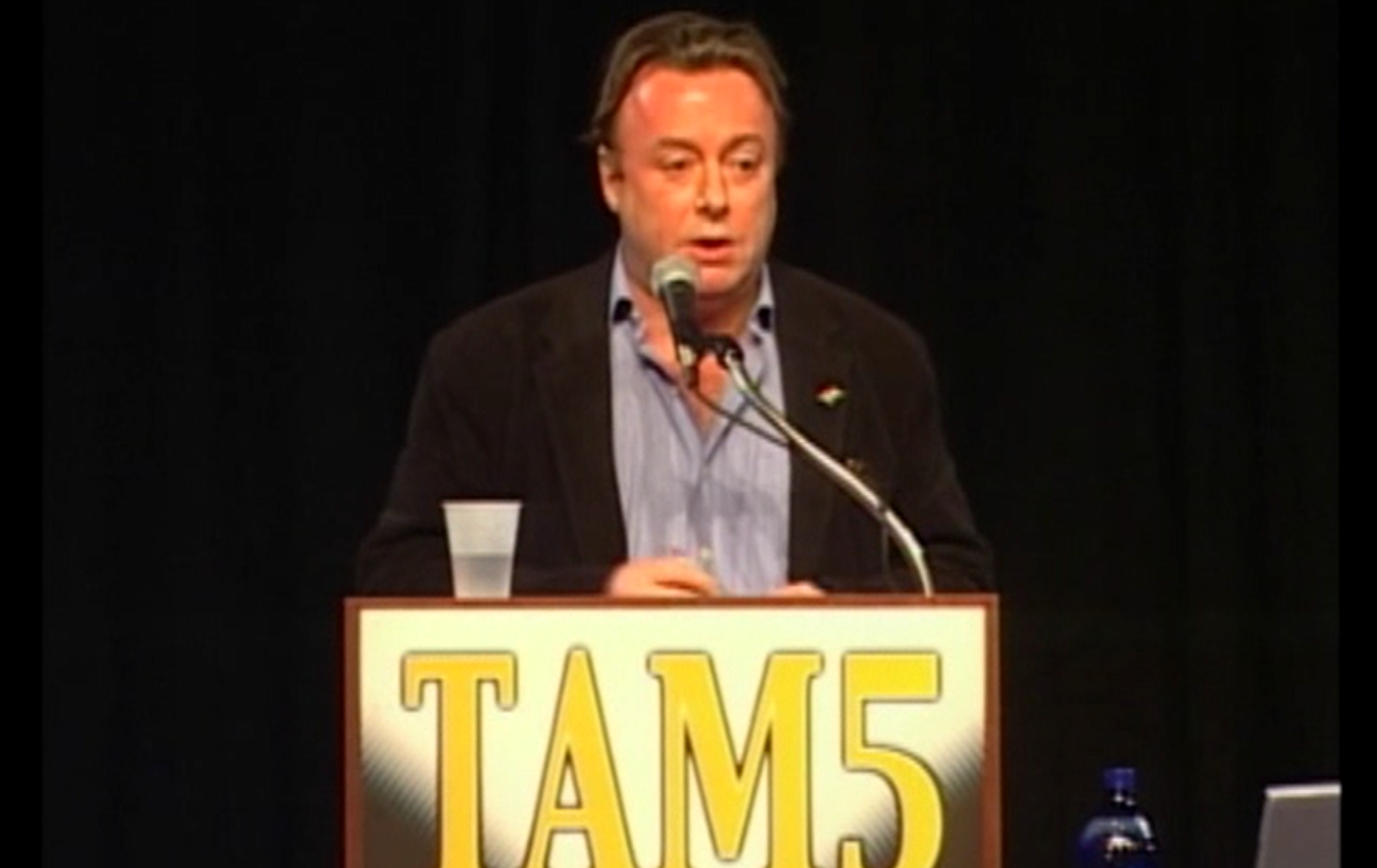
Thank you, Randy, for having me again. I have the impression that people like yourselves come to meetings like this not just to listen, but to talk. Since we only have 45 minutes together, I'll be as brief as I can on my topic and invite your responses. I think I must need to be

Date published: TBC
There is more to inspire awe in one page of Stephen Hawking than in any of the fantasies of Tertullian, imagining that he could go to the window of heaven when he was promoted there and look down for his consolation on the torments of the damned.

Date published: TBC
The notion that faith and morality are synonymous, when considering historical practices such as religious rituals involving human sacrifice, not only raises ethical concerns but also reflects a deep-seated fear among followers of these beliefs. The narrative of overcoming inequality through shared suffering has long been part of this tradition.

Date published: TBC
The illusion of God is a critique of theism that reveals the flaws in religious metaphysical claims. Hitchens argues that these claims are not true, but rather false and rooted in humanity's infancy as a species. They also highlight the limitations of human understanding and the dangers of totalitarianism that come with believing in a creator or designer.

Date published: TBC
Hitchens argues that the faith is not only untrue but also immoral. He challenges the idea that morality comes from the supernatural and instead suggests that it arises from human solidarity and predates all forms of monotheism.

Date published: TBC
Hitchens challenges the notion that belief in a deity is necessary for morality and intellectual freedom. Drawing on historical examples, such as the Vatican's recent retraction of Limbo and papal apologies for past injustices, the speaker argues that religious beliefs often lead to moral tyranny and violence. He asserts that theism, unlike deism, imposes a totalitarian view of existence that undermines human autonomy.

Date published: TBC
"I'd like to assure you, ladies and gentlemen, brothers and sisters, comrades and friends, that that isn't the best that Frank can do. He ended with that pious hope. He must indeed hope it isn't. I've seen him do better in his 20 minutes. He barely got his trousers off, as a matter of fact, before he had to sit down because he didn't get beyond deism."

Date: July 8, 2008
Opening With your permission, I'll take Dinesh's points in, so to say, reverse order. The last one will be reverberating in your heads, the loudest, I dare say. It was not I, the atheist, but Archbishop Rowan Williams, the head of the Anglican and Episcopalian Communion, who recently demanded that Britain adopt sharia
Date: October 22, 2007
Hitchens challenges D'Souza's view that monotheism is essential for morality. Hitchens argues that morality predates God, cites historical evidence of slavery mandated in holy texts, and provocatively asks whether one would prefer a baby to become a Wahhabi Muslim or a secular humanist.
Date: TBC
Thank you, Randy, for having me again. I have the impression that people like yourselves come to meetings like this not just to listen, but to talk. Since we only have 45 minutes together, I'll be as brief as I can on my topic and invite your responses. I think I must need to be
Date: March 23, 2000
There is more to inspire awe in one page of Stephen Hawking than in any of the fantasies of Tertullian, imagining that he could go to the window of heaven when he was promoted there and look down for his consolation on the torments of the damned.
Date: October 7, 2007
The notion that faith and morality are synonymous, when considering historical practices such as religious rituals involving human sacrifice, not only raises ethical concerns but also reflects a deep-seated fear among followers of these beliefs. The narrative of overcoming inequality through shared suffering has long been part of this tradition.
Date: May 14, 2007
The illusion of God is a critique of theism that reveals the flaws in religious metaphysical claims. Hitchens argues that these claims are not true, but rather false and rooted in humanity's infancy as a species. They also highlight the limitations of human understanding and the dangers of totalitarianism that come with believing in a creator or designer.
Date: October 2, 2007
Hitchens argues that the faith is not only untrue but also immoral. He challenges the idea that morality comes from the supernatural and instead suggests that it arises from human solidarity and predates all forms of monotheism.
Date: September 9, 2008
Hitchens challenges the notion that belief in a deity is necessary for morality and intellectual freedom. Drawing on historical examples, such as the Vatican's recent retraction of Limbo and papal apologies for past injustices, the speaker argues that religious beliefs often lead to moral tyranny and violence. He asserts that theism, unlike deism, imposes a totalitarian view of existence that undermines human autonomy.
Date: August 9, 2009
"I'd like to assure you, ladies and gentlemen, brothers and sisters, comrades and friends, that that isn't the best that Frank can do. He ended with that pious hope. He must indeed hope it isn't. I've seen him do better in his 20 minutes. He barely got his trousers off, as a matter of fact, before he had to sit down because he didn't get beyond deism."
