
The infrastructure and content of the transcriptions have taken hundreds of hours by one person. You can contribute to the software and hosting used for Reflectoria, the Christopher Hitchens Facebook page, and this website by buying a coffee or subscribing on Facebook.
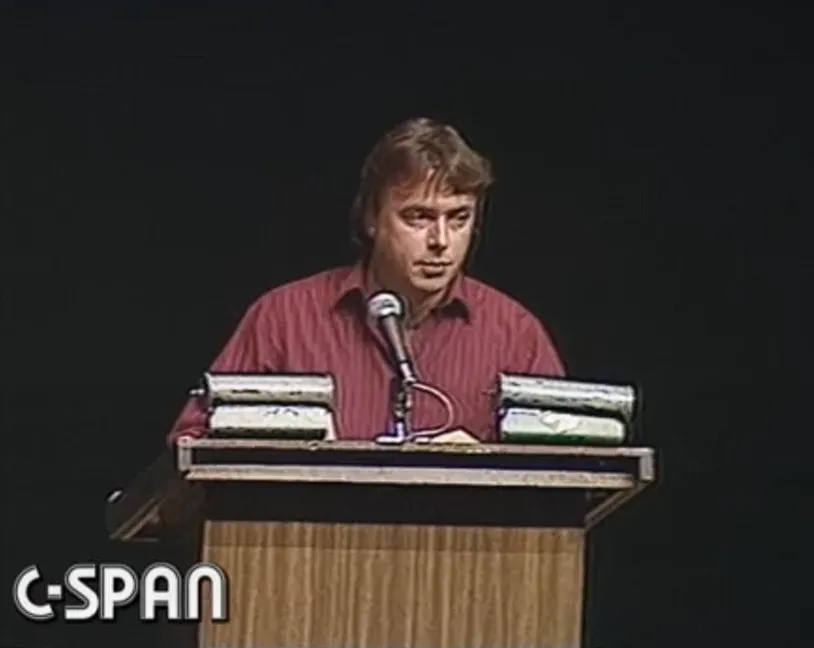
Opening – Christopher Hitchens
Thank you, professor.
Very generous introduction.
Thank you, ladies and gentlemen.
My first duty, which is also a pleasure,
is to thank the University of Notre Dame for inviting me onto its terrain.
And Mr. O’Duffy in particular, in an institution that’s also identified with the great history and people of Ireland for taking the revenge of arranging for English weather–
[LAUGHTER]
–to greet me.
Now I could do it in a way and two, like this as a proposition.
When Gertrude Stein was dying, she asked, as her last hour approached, well, what is the answer?
And when no one around her bed spoke, she rephrased and said, well, in that case, what is the question?
And I’m speaking tonight. We are speaking tonight. We’re met tonight at an institution of higher learning.
The greatest obligation that you have is to keep an open mind.
And to realize that in our present state, human society, we’re more and more overborn by how little we know and how little we know about more and more.
If you like, how much more we know, but how much less we know as we find out how much more and more there is to know.
In these circumstances, which I believe to be undeniable, the only respectable intellectual position is one of doubt, skepticism, reservation, and free – and I’d stress free and unfettered – inquiry in that lies, as it has always lain, our only hope.
So you should beware always of those who say that these questions have already been decided.
In particular, to those who tell you that they’ve been decided by revelation, that there are handed down commandments and precepts that predate ourselves.
And that the answers are already available if only we could see them.
And that the obligation upon ourselves to debate ethical and moral and historical and other questions is thereby dissolved.
It seems to me that that is the one position – it’s what I call the faith position – that has to be discarded first.
So thank you for your attention, and I’m done. Except that, it seems that I have a reputation for demagogy to live up to.
When I come to a place like this, I read the local paper – the campus observer, in this case.
And I was sorry to see that Dinesh and I are not considered up to the standards of Father Richard McBrien, whose exacting standards, I dare say, are out of our reach.
And I was also sorry to see myself and others represented in other papers.
And in particular, by a distinguished cleric in St. Peter’s on Good Friday, who made a speech through which His Holiness the Pope sat in silence, Father Cantal and Messer, saying that people like myself are part of a pogrom, a persecution comparable only to that of the Jews, with the church in mind.
This is the first time I’ve ever been accused of being part of a pogrom or a persecution.
But as long as it’s going on, I’ll also add that it’s the only pogrom I’ve ever heard of that’s led by small, deaf and dumb children whose cries for justice have been ignored.
And while that is the definition of the pogrom, I’ll continue to support it, because I think it demonstrates very clearly the moral superiority of the secular concept of justice and law over canon law and religious law, with its sickly emphasis on self-exculpation in the guise of forgiveness and redemption.
That’s not the only reason why religion is a problem. It’s a problem principally because it is man-made, because to an extent it is true, as the church used to preach when it had more confidence, that we are, in some sense, originally sinful and guilty.
If you want to prove that, you only have to look at the many religions that people have constructed to see that they are indeed the product of an imperfectly evolved primate species, about half a chromosome away from a chimpanzee, with a prefrontal lobe that’s too small, an adrenaline gland that’s too big, and various other evolutionary deformities about which we’re finding out ever more.
A species that is predatory. A man is a wolf to man, Homo homini lupus, as has well been said. A species that’s very fearful of itself and others and of the natural order.
And above all, very, very willing, despite its protestations of religious modesty, to be convinced that the operations of the cosmos and the universe are all operating with us in mind.
Make up your mind whether you want to be modest or not. But don’t say that you are made out of dust, or if you’re a woman out of a bit of rib, or if you’re a Muslim out of a clot of blood, and you’re an abject sinner born into guilt. But add, nonetheless, let’s cheer up.
The whole universe is still designed with you in mind. This is not modesty or humility. It’s a man-made false consolation in my judgment. And it does great moral damage. It warps.
It begins by warping what we might call our moral sense of proportion.
I wish that was all that could be said, though I think that’s the most important thing. I ought to say why I think it ought to be credited. And I ought to add that my colleagues Richard Dawkins and Daniel Dennett have been very generous in this respect.
This debate would be uninteresting if religion was one dimensional. Religion was our first attempt to make sense of our surroundings. It was our first attempt at cosmology, for example, to make sense of what goes on in the heavens. It was our first attempt at what I care about the most, the study of literature and literary criticism.
It gave us texts to deliberate and even to debate about, even if some of those texts were held to be the word of God and beyond review and beyond criticism, nonetheless, the idea is introduced and it had never been introduced before.
It’s our first attempt at healthcare in one way. If you go to the shaman or the witch doctor and you make the right propitiations, the right sacrifices, and you really believe in it, you do have a better chance of recovery. Everybody knows it’s a medical fact. Morale is an ingredient in health.
And it was our first attempt at that too. It was our first very bad attempt at human solidarity because it was tribe based. But nonetheless, it taught that there were virtues in sticking together. And it was our first attempt, I would say also, this is not an exhaustive list, at psychiatric care, at dealing with the terrible loneliness of the human condition.
That what happens when the individual spirit looks out shivering into the enormous void of the cosmos and contemplates its own extinction and deals with the awful fear of death. This was the first attempt to apply any balm to that awful question.
But as Charles Darwin says of our own evident kinship with lower mammals and lower forms of life, we bear always the ineffaceable stamp of our lowly origin. I’ll repeat it, the ineffaceable stamp of our lowly origin. Religion does the same thing.
It quite clearly shows that it’s the first, the most primitive, the most crude, and the most deluded attempt to make sense. It is the worst attempt, but partly because it was the first. So the credit can be divided in that way.
And the worst thing it did was to offer us certainty, to say these are truths that are unalterable, they’re handed down from on high, we only have to learn God’s will and how to obey it in order to free ourselves from these dilemmas. That’s probably the worst advice of all.
Heinrich Heiner says that if you’re in a dark wood on a dark night and you don’t know where you are and you’ve never been through this territory before, you may be well advised to hire as a guide the local mad, blind old man who can feel his way through the forest, because he can do something you can’t.
But when the dawn breaks and the light comes, you would be silly if you continued to operate with this guide, this blind, mad old man who was doing his best with the first attempt. To give you just two very contemporary examples, to have a germ theory of disease relieves you of the idea that plagues are punishments.
That the church used to preach, that plagues come because the Jews have poisoned the wells as the church very often preached, or that the Jews even exist and are themselves a plague as the church used to preach when it felt strong enough and also was morally weak enough and had such little evidence.
You can free yourself from the idea that diseases are punishments or visitations. If you study plate tectonics, you won’t do what the Archbishop of Haiti did the other day, speaking to his sorrowing people after his predecessor had been buried in the ruins of the cathedral at Port-au-Prince, along with a quarter of a million other unfortunate Haitians whose lives were miserable enough as it was.
And to say, with the Cardinal Archbishop of New York standing next to him, that God had something to say to Haiti and this is the way he chose to say it. If you study plate tectonics and a few other things, you will free yourself of this appalling burden from our superstitious, fearful primate past.
And I suggest again, to an institution of higher learning, that’s a responsibility we all have to take on. If we reflect, some people say, the great Stephen Jay Gould, who I admired very much, when we all learned a great deal about evolutionary biology, used to say, rather leniently, I think, that well, these are non-overlapping magisteria.
The material world, the scientific world, and the faith world. I think non-overlapping is too soft. I think it’s more a question, really increasingly, of it being a matter of incompatibility or, perhaps better to say, irreconcilability.
Just if you reflect on a few things I’ll have time, I hope, to mention. My timer, by the way, isn’t running, so I’m under your discipline, Professor. You’ll give me – We have about four and a half minutes. – Very good.
When we reflect that the rate of expansion of our universe is increasing, it was thought until Hubble that we knew it was expanding, but that surely Newton would teach us that the rate would diminish. No, the rate is increasing, the Big Bang is speeding up.
We can see the end of it coming increasingly clearly and while we wait for that, we can see the galaxy of Andromeda moving nearer towards the collision that’s coming with us. You can see it now in the night sky.
This is the object of a design, you think? What kind of designer in that case? To say that this must have an origin and now we know how it’s going to end, why ask why there’s something rather than nothing when you can see the nothingness coming, only replaces the question.
Faith is of no use in deciding it and that’s on the macro level. From the macro to the micro, 99.8% of all species ever created, if you insist, on the face of this planet have already become extinct, leaving no descendants.
I might add that of that number, three or four branches of our own family, Homo sapiens, branches of it, the Cro-Magnons, the Neanderthals, who were living with us until about 50,000 years ago, who had tools, who made art, who decorated graves, who clearly had a religion, who must have had a God, who must have abandoned them, who must have let them go.
They’re no longer with us. We don’t know what their last cries were like and our own species was down to about 10,000 in Africa before we finally got out of there, unforesaken this time or so far, to move from the macro, in other words, to the micro.
Our own solar system is only halfway through it. It’s allotted span before it blows up and as Sir Martin Ryle, the great astronomer Ryle and professor of cosmology at Cambridge and incidentally a believing Anglican says, by the time there are creatures on the Earth who look as the sun expires, they will not be human.
Will not be humans who see this happen if our planet lives that long. The creatures that watch it happen will be as far different from us as we are from amoebae and bacteria.
Faced with these amazing, overarching, titanic, I would say awe-inspiring facts, like the fact that ever since the Big Bang every single second a star the size of ours has blown up. While I’ve been talking, once every second a star the size of our sun has gone out.
Faced with these amazing indisputable facts, can you be brought to believe that the main events in human history, the crucial ones happened 3,000 to 2,000 years ago in illiterate desert Arabia and Palestine and that it was at that moment only that the heavens decided it was time to intervene and that by those interventions we can ask for salvation.
Can you be brought to believe this? I stand before you as someone who quite simply cannot and who refuses furthermore to be told that if I don’t believe it, I wouldn’t have any source for ethics or morality. Please don’t pile the insulting onto the irrational and tell me that if I don’t accept these sacrifices in the desert, I have no reason to tell right from wrong.
One minute. One minute, good. Then I’ll have to prune and you’ll be the losers, but I’ll have a rebuttal coming. All right, look at the contemporary religious scene. I return to religion as well as faith and belief.
Israeli settlers are stealing other people’s land in the hope of bringing on the Messiah and a terrible war. On the alternative side, as it thinks of itself, the Islamic jihadists are preparing a war without end, a faith-based war based on the repulsive tactic of suicide murder and all of these people believe that they have a divine warrant, a holy book, and the direct word of God on their side.
We used to worry when I was young what will happen when a maniac gets hold of a nuclear weapon? We’re about to discover what happens when that happens. The Islamic Republic of Iran is about to get a nuclear weapon and by illegal means that flout every possible international law and treaty.
Meanwhile, in Russia, the authoritarian chauvinistic expansionist regime of Vladimir Putin is increasingly decked in clerical garb by the Russian Orthodox Church with its traditional allegiance to Tsarism, serfdom, and the rest of it. And Dinesh would have to argue, I’ll close on this, Dinesh would have to argue that surely that’s better than it be a mass outbreak of secularism in Russia and Iran and Israel and Saudi Arabia.
And I would call that a reductio ad absurdum. And I’ll leave you with it and I’ll be back, thanks.
Rebuttal – Christopher Hitchens
I never heard Dinesh doing that without thinking what a wonderful Muslim he would make. You try telling a hundred people in Saudi Arabia that you don’t think the Prophet Mohammed really heard those voices, you can be really outvoted.
And yes, Dinesh, I have noticed there are religious revivals going on, pay a lot of attention to them. I don’t find them as welcome perhaps as you do. And on your detective hypothesis, don’t you think there’s something to be said for considering falsifiability when constructing a hypothesis? For example, Albert Einstein staked his reputation.
He said, “If I’m wrong about this, then there will not be an eclipse at a certain time of day and month and year off the west coast of Africa, and I will look a fool. But if I’m right, there will be one,” and people for gathered thinking he can’t be that smart, and he was. Professor JBS Haldane used to be asked, “What would shake your faith in evolution?” This was when it was much more controversial than it is now.
And I’m impressed to find that Dinesh believes in intelligent design, which really does require, I would think, a leap of faith. But there it is. Haldane said, “Show me rabbits burns in the Jurassic lair, and I’ll give up.” Now, can you think of any religious spokesman you’ve ever heard who would tell you in advance what would disprove their hypothesis?
Of course, you can’t because it’s unfalsifiable. And we were all taught, weren’t we, by Professor Karl Popper, that unfalsifiability in a theory is a test, not of its strength but of its weakness. So you can’t beat it.
The church used to say, “No, God didn’t allow evolution. Indy, instead, he hid the bones in the rocks to test our faith.” It didn’t work out too well. So now they say, “Now we know about it, it proves how incredibly clever he was all along.”
It’s an infinitely elastic airbag, and there’s no argument that I can bring or anyone else can bring against it. And that’s what should make you suspicious. Then a question for Dinesh.
Sure, I know I’m supposed to be answering them as well as asking them, but it does intrigue me when I debate with religious people. He announces the heaviest words he was going to talk with reference to revelation, scripture, or scriptural authority. Now, why ask yourselves then? Not ask you, why is that? Why do I never come up against someone who says, “I’ll tell you why I’m religious because I think that Jesus of Nazareth is the way, the truth, and the life, and no one comes to the Father except by him. And if you’ll believe on this, you will be given eternal life.” I’d be impressed if people would sometimes say that.
Why do the religious people so often feel they must say, “No, we don’t, what that’s all sort of metaphorical.” In what sense are they then religious?
You’ll notice that Dinesh talked about the operations of the divine and the Creator only in the observable natural order. That’s what used to be called the deist position. It was the position held by skeptics like Thomas Paine and Thomas Jefferson by the end of the 18th century. It was as far as anyone could see before Darwin and before Einstein. There appeared to be evidence of design in the universe, but there was no evidence of divine intervention in it.
The deist may say, and I would have to say, it cannot be disproved that there was a first cause and that it was godly. That cannot be disproved; it can only be argued there’s no evidence for it. But the deists, having established that position, if they have, has all their works to the head of them to show that there is a God who cares about us, even knows we exist, takes sides in our little tribal wars, cares who we sleep with and in what position, cares what we eat and on what day of the week, arbitrates matters of this kind.
That’s the conceit, that’s the endless human wish to believe that we have parents who want to look out for us and help us not to grow up or get out of the way. And so, it surprises me that there are no professions of real religious faith ever made on these occasions. Now, I suppose I should then say what my own method in this is since I was challenged on that point.
Take the two figures of Jesus of Nazareth and Socrates. I believe Jesus of Nazareth operates on me the fringe of mythology and prehistory. I don’t think it’s absolutely certainly established there was such a person or that he made those pronouncements or that he was the son of God or the son of a virgin or any of these things. And I would likewise have to concede that we only know the work of Socrates through secondhand sources, in the same way second or third hand, quite impressive ones in some cases, from Plato’s apology. But he can’t be demonstrated to me the Socrates ever walk the streets of Athens. If I couldn’t, it’s coming.
That’s fine. Very well, just quickly, that if it could be shown to a believing Christian the grave of Jesus opened and the body of him found and the resurrection disproved, if that could be archaeologically done for the sake of argument, it would presumably be a disaster for you. You’d have to think then we’re alone then, how we’re going to know right from wrong, what can we do?
I maintain with Socrates that, on the contrary, the moral problems and ethical problems and other dilemmas that we have would be exactly the same as they are. What are our duties to each other? How could we build the just city? How should we think? How can we face the possibility of our loneliness? How can we do right? And these questions would remain exactly as they are and as they do.
And so all that is necessary is to transcend the superstitious, transcend the mythical and accept the responsibility, take it on ourselves that no one can do this for us. And I would hope that in a great university that thought might carry the day. Thank you.
Opening – Christopher Hitchens
Thank you, professor.
Very generous introduction.
Thank you, ladies and gentlemen.
My first duty, which is also a pleasure,
is to thank the University of Notre Dame for inviting me onto its terrain.
And Mr. O’Duffy in particular, in an institution that’s also identified with the great history and people of Ireland for taking the revenge of arranging for English weather–
[LAUGHTER]
–to greet me.
Now I could do it in a way and two, like this as a proposition.
When Gertrude Stein was dying, she asked, as her last hour approached, well, what is the answer?
And when no one around her bed spoke, she rephrased and said, well, in that case, what is the question?
And I’m speaking tonight. We are speaking tonight. We’re met tonight at an institution of higher learning.
The greatest obligation that you have is to keep an open mind.
And to realize that in our present state, human society, we’re more and more overborn by how little we know and how little we know about more and more.
If you like, how much more we know, but how much less we know as we find out how much more and more there is to know.
In these circumstances, which I believe to be undeniable, the only respectable intellectual position is one of doubt, skepticism, reservation, and free – and I’d stress free and unfettered – inquiry in that lies, as it has always lain, our only hope.
So you should beware always of those who say that these questions have already been decided.
In particular, to those who tell you that they’ve been decided by revelation, that there are handed down commandments and precepts that predate ourselves.
And that the answers are already available if only we could see them.
And that the obligation upon ourselves to debate ethical and moral and historical and other questions is thereby dissolved.
It seems to me that that is the one position – it’s what I call the faith position – that has to be discarded first.
So thank you for your attention, and I’m done. Except that, it seems that I have a reputation for demagogy to live up to.
When I come to a place like this, I read the local paper – the campus observer, in this case.
And I was sorry to see that Dinesh and I are not considered up to the standards of Father Richard McBrien, whose exacting standards, I dare say, are out of our reach.
And I was also sorry to see myself and others represented in other papers.
And in particular, by a distinguished cleric in St. Peter’s on Good Friday, who made a speech through which His Holiness the Pope sat in silence, Father Cantal and Messer, saying that people like myself are part of a pogrom, a persecution comparable only to that of the Jews, with the church in mind.
This is the first time I’ve ever been accused of being part of a pogrom or a persecution.
But as long as it’s going on, I’ll also add that it’s the only pogrom I’ve ever heard of that’s led by small, deaf and dumb children whose cries for justice have been ignored.
And while that is the definition of the pogrom, I’ll continue to support it, because I think it demonstrates very clearly the moral superiority of the secular concept of justice and law over canon law and religious law, with its sickly emphasis on self-exculpation in the guise of forgiveness and redemption.
That’s not the only reason why religion is a problem. It’s a problem principally because it is man-made, because to an extent it is true, as the church used to preach when it had more confidence, that we are, in some sense, originally sinful and guilty.
If you want to prove that, you only have to look at the many religions that people have constructed to see that they are indeed the product of an imperfectly evolved primate species, about half a chromosome away from a chimpanzee, with a prefrontal lobe that’s too small, an adrenaline gland that’s too big, and various other evolutionary deformities about which we’re finding out ever more.
A species that is predatory. A man is a wolf to man, Homo homini lupus, as has well been said. A species that’s very fearful of itself and others and of the natural order.
And above all, very, very willing, despite its protestations of religious modesty, to be convinced that the operations of the cosmos and the universe are all operating with us in mind.
Make up your mind whether you want to be modest or not. But don’t say that you are made out of dust, or if you’re a woman out of a bit of rib, or if you’re a Muslim out of a clot of blood, and you’re an abject sinner born into guilt. But add, nonetheless, let’s cheer up.
The whole universe is still designed with you in mind. This is not modesty or humility. It’s a man-made false consolation in my judgment. And it does great moral damage. It warps.
It begins by warping what we might call our moral sense of proportion.
I wish that was all that could be said, though I think that’s the most important thing. I ought to say why I think it ought to be credited. And I ought to add that my colleagues Richard Dawkins and Daniel Dennett have been very generous in this respect.
This debate would be uninteresting if religion was one dimensional. Religion was our first attempt to make sense of our surroundings. It was our first attempt at cosmology, for example, to make sense of what goes on in the heavens. It was our first attempt at what I care about the most, the study of literature and literary criticism.
It gave us texts to deliberate and even to debate about, even if some of those texts were held to be the word of God and beyond review and beyond criticism, nonetheless, the idea is introduced and it had never been introduced before.
It’s our first attempt at healthcare in one way. If you go to the shaman or the witch doctor and you make the right propitiations, the right sacrifices, and you really believe in it, you do have a better chance of recovery. Everybody knows it’s a medical fact. Morale is an ingredient in health.
And it was our first attempt at that too. It was our first very bad attempt at human solidarity because it was tribe based. But nonetheless, it taught that there were virtues in sticking together. And it was our first attempt, I would say also, this is not an exhaustive list, at psychiatric care, at dealing with the terrible loneliness of the human condition.
That what happens when the individual spirit looks out shivering into the enormous void of the cosmos and contemplates its own extinction and deals with the awful fear of death. This was the first attempt to apply any balm to that awful question.
But as Charles Darwin says of our own evident kinship with lower mammals and lower forms of life, we bear always the ineffaceable stamp of our lowly origin. I’ll repeat it, the ineffaceable stamp of our lowly origin. Religion does the same thing.
It quite clearly shows that it’s the first, the most primitive, the most crude, and the most deluded attempt to make sense. It is the worst attempt, but partly because it was the first. So the credit can be divided in that way.
And the worst thing it did was to offer us certainty, to say these are truths that are unalterable, they’re handed down from on high, we only have to learn God’s will and how to obey it in order to free ourselves from these dilemmas. That’s probably the worst advice of all.
Heinrich Heiner says that if you’re in a dark wood on a dark night and you don’t know where you are and you’ve never been through this territory before, you may be well advised to hire as a guide the local mad, blind old man who can feel his way through the forest, because he can do something you can’t.
But when the dawn breaks and the light comes, you would be silly if you continued to operate with this guide, this blind, mad old man who was doing his best with the first attempt. To give you just two very contemporary examples, to have a germ theory of disease relieves you of the idea that plagues are punishments.
That the church used to preach, that plagues come because the Jews have poisoned the wells as the church very often preached, or that the Jews even exist and are themselves a plague as the church used to preach when it felt strong enough and also was morally weak enough and had such little evidence.
You can free yourself from the idea that diseases are punishments or visitations. If you study plate tectonics, you won’t do what the Archbishop of Haiti did the other day, speaking to his sorrowing people after his predecessor had been buried in the ruins of the cathedral at Port-au-Prince, along with a quarter of a million other unfortunate Haitians whose lives were miserable enough as it was.
And to say, with the Cardinal Archbishop of New York standing next to him, that God had something to say to Haiti and this is the way he chose to say it. If you study plate tectonics and a few other things, you will free yourself of this appalling burden from our superstitious, fearful primate past.
And I suggest again, to an institution of higher learning, that’s a responsibility we all have to take on. If we reflect, some people say, the great Stephen Jay Gould, who I admired very much, when we all learned a great deal about evolutionary biology, used to say, rather leniently, I think, that well, these are non-overlapping magisteria.
The material world, the scientific world, and the faith world. I think non-overlapping is too soft. I think it’s more a question, really increasingly, of it being a matter of incompatibility or, perhaps better to say, irreconcilability.
Just if you reflect on a few things I’ll have time, I hope, to mention. My timer, by the way, isn’t running, so I’m under your discipline, Professor. You’ll give me – We have about four and a half minutes. – Very good.
When we reflect that the rate of expansion of our universe is increasing, it was thought until Hubble that we knew it was expanding, but that surely Newton would teach us that the rate would diminish. No, the rate is increasing, the Big Bang is speeding up.
We can see the end of it coming increasingly clearly and while we wait for that, we can see the galaxy of Andromeda moving nearer towards the collision that’s coming with us. You can see it now in the night sky.
This is the object of a design, you think? What kind of designer in that case? To say that this must have an origin and now we know how it’s going to end, why ask why there’s something rather than nothing when you can see the nothingness coming, only replaces the question.
Faith is of no use in deciding it and that’s on the macro level. From the macro to the micro, 99.8% of all species ever created, if you insist, on the face of this planet have already become extinct, leaving no descendants.
I might add that of that number, three or four branches of our own family, Homo sapiens, branches of it, the Cro-Magnons, the Neanderthals, who were living with us until about 50,000 years ago, who had tools, who made art, who decorated graves, who clearly had a religion, who must have had a God, who must have abandoned them, who must have let them go.
They’re no longer with us. We don’t know what their last cries were like and our own species was down to about 10,000 in Africa before we finally got out of there, unforesaken this time or so far, to move from the macro, in other words, to the micro.
Our own solar system is only halfway through it. It’s allotted span before it blows up and as Sir Martin Ryle, the great astronomer Ryle and professor of cosmology at Cambridge and incidentally a believing Anglican says, by the time there are creatures on the Earth who look as the sun expires, they will not be human.
Will not be humans who see this happen if our planet lives that long. The creatures that watch it happen will be as far different from us as we are from amoebae and bacteria.
Faced with these amazing, overarching, titanic, I would say awe-inspiring facts, like the fact that ever since the Big Bang every single second a star the size of ours has blown up. While I’ve been talking, once every second a star the size of our sun has gone out.
Faced with these amazing indisputable facts, can you be brought to believe that the main events in human history, the crucial ones happened 3,000 to 2,000 years ago in illiterate desert Arabia and Palestine and that it was at that moment only that the heavens decided it was time to intervene and that by those interventions we can ask for salvation.
Can you be brought to believe this? I stand before you as someone who quite simply cannot and who refuses furthermore to be told that if I don’t believe it, I wouldn’t have any source for ethics or morality. Please don’t pile the insulting onto the irrational and tell me that if I don’t accept these sacrifices in the desert, I have no reason to tell right from wrong.
One minute. One minute, good. Then I’ll have to prune and you’ll be the losers, but I’ll have a rebuttal coming. All right, look at the contemporary religious scene. I return to religion as well as faith and belief.
Israeli settlers are stealing other people’s land in the hope of bringing on the Messiah and a terrible war. On the alternative side, as it thinks of itself, the Islamic jihadists are preparing a war without end, a faith-based war based on the repulsive tactic of suicide murder and all of these people believe that they have a divine warrant, a holy book, and the direct word of God on their side.
We used to worry when I was young what will happen when a maniac gets hold of a nuclear weapon? We’re about to discover what happens when that happens. The Islamic Republic of Iran is about to get a nuclear weapon and by illegal means that flout every possible international law and treaty.
Meanwhile, in Russia, the authoritarian chauvinistic expansionist regime of Vladimir Putin is increasingly decked in clerical garb by the Russian Orthodox Church with its traditional allegiance to Tsarism, serfdom, and the rest of it. And Dinesh would have to argue, I’ll close on this, Dinesh would have to argue that surely that’s better than it be a mass outbreak of secularism in Russia and Iran and Israel and Saudi Arabia.
And I would call that a reductio ad absurdum. And I’ll leave you with it and I’ll be back, thanks.
Rebuttal – Christopher Hitchens
I never heard Dinesh doing that without thinking what a wonderful Muslim he would make. You try telling a hundred people in Saudi Arabia that you don’t think the Prophet Mohammed really heard those voices, you can be really outvoted.
And yes, Dinesh, I have noticed there are religious revivals going on, pay a lot of attention to them. I don’t find them as welcome perhaps as you do. And on your detective hypothesis, don’t you think there’s something to be said for considering falsifiability when constructing a hypothesis? For example, Albert Einstein staked his reputation.
He said, “If I’m wrong about this, then there will not be an eclipse at a certain time of day and month and year off the west coast of Africa, and I will look a fool. But if I’m right, there will be one,” and people for gathered thinking he can’t be that smart, and he was. Professor JBS Haldane used to be asked, “What would shake your faith in evolution?” This was when it was much more controversial than it is now.
And I’m impressed to find that Dinesh believes in intelligent design, which really does require, I would think, a leap of faith. But there it is. Haldane said, “Show me rabbits burns in the Jurassic lair, and I’ll give up.” Now, can you think of any religious spokesman you’ve ever heard who would tell you in advance what would disprove their hypothesis?
Of course, you can’t because it’s unfalsifiable. And we were all taught, weren’t we, by Professor Karl Popper, that unfalsifiability in a theory is a test, not of its strength but of its weakness. So you can’t beat it.
The church used to say, “No, God didn’t allow evolution. Indy, instead, he hid the bones in the rocks to test our faith.” It didn’t work out too well. So now they say, “Now we know about it, it proves how incredibly clever he was all along.”
It’s an infinitely elastic airbag, and there’s no argument that I can bring or anyone else can bring against it. And that’s what should make you suspicious. Then a question for Dinesh.
Sure, I know I’m supposed to be answering them as well as asking them, but it does intrigue me when I debate with religious people. He announces the heaviest words he was going to talk with reference to revelation, scripture, or scriptural authority. Now, why ask yourselves then? Not ask you, why is that? Why do I never come up against someone who says, “I’ll tell you why I’m religious because I think that Jesus of Nazareth is the way, the truth, and the life, and no one comes to the Father except by him. And if you’ll believe on this, you will be given eternal life.” I’d be impressed if people would sometimes say that.
Why do the religious people so often feel they must say, “No, we don’t, what that’s all sort of metaphorical.” In what sense are they then religious?
You’ll notice that Dinesh talked about the operations of the divine and the Creator only in the observable natural order. That’s what used to be called the deist position. It was the position held by skeptics like Thomas Paine and Thomas Jefferson by the end of the 18th century. It was as far as anyone could see before Darwin and before Einstein. There appeared to be evidence of design in the universe, but there was no evidence of divine intervention in it.
The deist may say, and I would have to say, it cannot be disproved that there was a first cause and that it was godly. That cannot be disproved; it can only be argued there’s no evidence for it. But the deists, having established that position, if they have, has all their works to the head of them to show that there is a God who cares about us, even knows we exist, takes sides in our little tribal wars, cares who we sleep with and in what position, cares what we eat and on what day of the week, arbitrates matters of this kind.
That’s the conceit, that’s the endless human wish to believe that we have parents who want to look out for us and help us not to grow up or get out of the way. And so, it surprises me that there are no professions of real religious faith ever made on these occasions. Now, I suppose I should then say what my own method in this is since I was challenged on that point.
Take the two figures of Jesus of Nazareth and Socrates. I believe Jesus of Nazareth operates on me the fringe of mythology and prehistory. I don’t think it’s absolutely certainly established there was such a person or that he made those pronouncements or that he was the son of God or the son of a virgin or any of these things. And I would likewise have to concede that we only know the work of Socrates through secondhand sources, in the same way second or third hand, quite impressive ones in some cases, from Plato’s apology. But he can’t be demonstrated to me the Socrates ever walk the streets of Athens. If I couldn’t, it’s coming.
That’s fine. Very well, just quickly, that if it could be shown to a believing Christian the grave of Jesus opened and the body of him found and the resurrection disproved, if that could be archaeologically done for the sake of argument, it would presumably be a disaster for you. You’d have to think then we’re alone then, how we’re going to know right from wrong, what can we do?
I maintain with Socrates that, on the contrary, the moral problems and ethical problems and other dilemmas that we have would be exactly the same as they are. What are our duties to each other? How could we build the just city? How should we think? How can we face the possibility of our loneliness? How can we do right? And these questions would remain exactly as they are and as they do.
And so all that is necessary is to transcend the superstitious, transcend the mythical and accept the responsibility, take it on ourselves that no one can do this for us. And I would hope that in a great university that thought might carry the day. Thank you.
continue reading
Related Posts


Raw transcript will be posted here.
